
A studio service
Characters built to be drawn a thousand more times.
A character design is not one nice illustration. It's a specification: turnarounds, expressions, proportions, palette and rules, packaged so that anyone — you, us, a colourist, an animator, a merchandise printer — can reproduce that character on-model, forever. We design characters for comics, children's books, brands and games, and we deliver the sheets, not just the pose.
Sample work
Sample work.
A model sheet is a reference document, not a portfolio piece: flat lighting, one shared baseline, and an expression range wide enough that every later panel can be drawn from it.
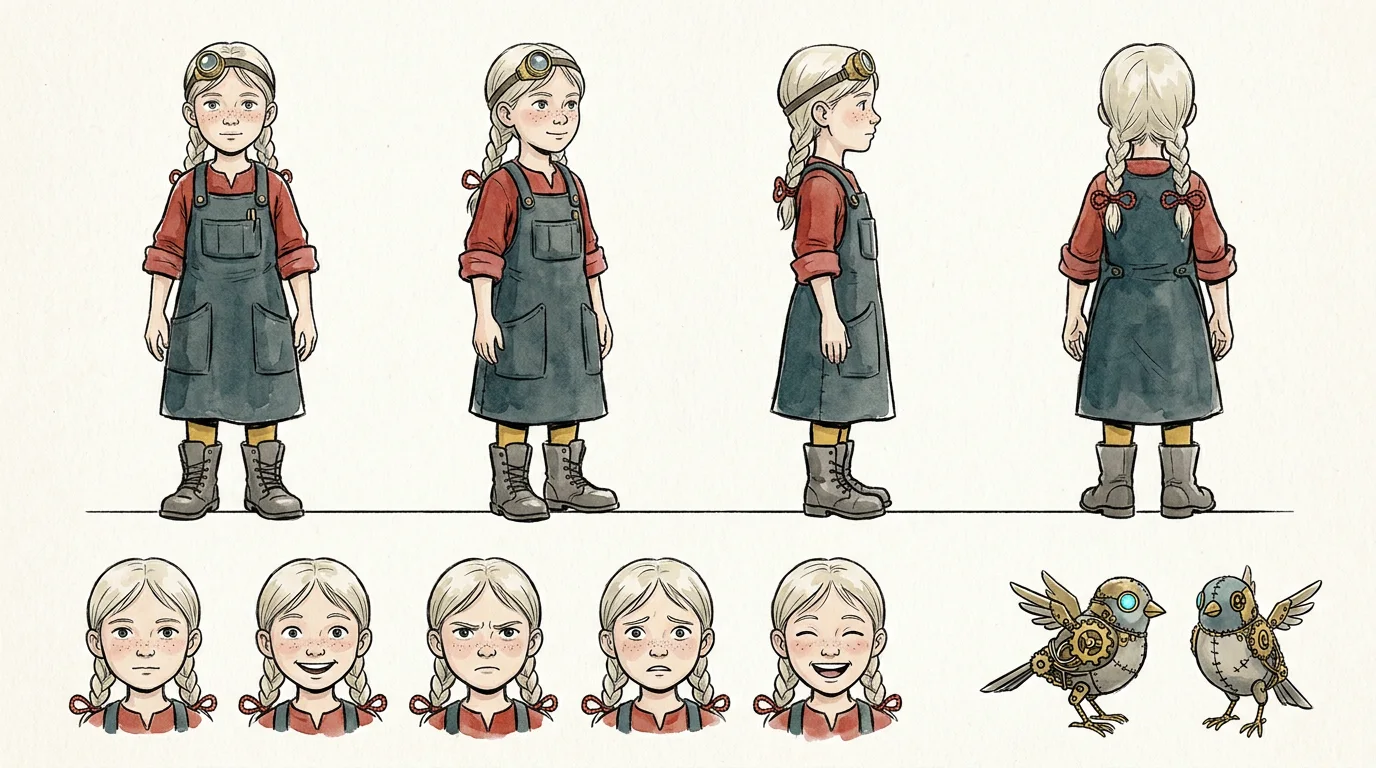
Character turnaround & expression sheet
One character, four views on a shared baseline, five expressions. This is the reference an illustrator draws every later panel from — and the reason a character still looks like herself two hundred pages in.
Studio demonstration pieces made to show the process — not client commissions.
N° 01What you receive
Not one drawing. A complete sheet.
The reason character design costs more than an illustration is that it has to answer questions nobody has asked yet. What does she look like from behind? What is her face doing when she's lying? What exact colour is the jacket lining on page ninety?
Everything below exists so those questions have an answer on a page instead of a guess made twice, differently, by two people.
01
Concept exploration
Several distinct directions for the character before anything is finalised — different silhouettes, ages and attitudes — so the choice is made against real options rather than the first idea that arrived.
02
Turnarounds
Front, three-quarter, side and back at locked proportions on a shared height guide. This is the sheet that makes a character reproducible by anyone, in any panel, at any angle.
03
Expression sheets
A grid of the emotions the story actually needs — not a generic happy-sad-angry set. Comics and picture books live on faces, so this sheet gets scoped from the script.
04
Model sheets & proportions
Head-height ratios, hand and eye construction, and the specific shape rules that make the character recognisable even in a two-centimetre panel.
05
Colour callouts
Every colour on the character specified with values, plus the shadow and highlight versions, so a colourist three chapters later matches exactly rather than approximately.
06
Poses & action set
A set of signature poses that show how the character moves, stands and occupies space — the difference between a design that sits still and one that acts.
N° 02Where it's used
One character, many surfaces.
The same discipline serves very different jobs. A comic needs a character that survives hundreds of panels drawn quickly. A picture book needs one that reads warmly at storytime scale. A brand needs one that works on a package, an app icon and a sticker sheet.
We scope the sheet to the surface. There's no point delivering a fifty-expression set for a mascot that will only ever wave, and no point delivering three expressions for a graphic novel that runs two hundred pages.
01
Comics & graphic novels
Designs built for repetition and speed: strong silhouettes, simplified construction, and costume detail that stays consistent when a page has to be drawn on a schedule.
02
Children's books
Warm, readable characters designed for the picture-book page and for the spreads to come — the same character sheet that carries a first title carries the whole series.
03
Brand characters & mascots
A character that holds up across packaging, app icons, signage and social — with the small-size rules and the do-not-do list written down so nobody deforms it later.
04
Games & interactive
Character concept art with the turnarounds and colour specification a modeller, animator or sprite artist needs to build from without guessing.
05
Casts and ensembles
Groups designed against each other, so silhouettes stay distinguishable, palettes don't collide, and a reader can tell who is who at a glance in a crowded panel.
06
Style bibles
The whole cast plus the rules — line weight, palette, proportion system, what breaks the style — collected into one document your team and any future illustrator can work from.
N° 03How to brief us
Design your own character, with a studio holding the pencil.
The best character briefs are behavioural, not visual. "Green hair, red coat" produces a costume. "She apologises for things that aren't her fault and always stands slightly too far away" produces a character — and the coat follows from it.
If you want to see how we think about this in depth before commissioning anything, our guide walks through the same process for picture-book characters, free and in full.
01
Start with behaviour
Tell us how the character moves, what they want, and what they do when they're nervous. Silhouette, posture and face all fall out of behaviour more reliably than from a shopping list of features.
02
Name the age band
Who is reading this decides almost everything — proportion, eye size, palette saturation, how much detail survives. A character for five-year-olds and one for twelve-year-olds are different builds.
03
Bring references, not templates
Mood boards and tone references are genuinely useful. Existing franchise characters are not something we'll work from or toward — the design has to be original and yours to own outright.
04
Say where it will live
Panels, spreads, packaging, screens — the surfaces set the rules. Small-size legibility and reproduction constraints are cheap to design in and expensive to retrofit.
05
Read the character design guide
Our free guide to children's book character design covers the same method in detail — worth reading before you brief, whether or not you commission us.
06
Expect revision at concept stage
Revisions belong early, on the concept sheet, while a change costs a sketch. Once turnarounds and colour callouts are built on an approved design, changing it means rebuilding the set.
Investment
Named engagements. Quoted per project.
From one fully specified character to a complete style bible a production team can work from. Scope is set by cast size and how much of the sheet your project genuinely needs — each engagement is quoted per project.
Single character
Quoted per projectone character
One protagonist or mascot, fully specified and ready to draw from.
- Concept exploration, several directions
- Full turnaround
- Core expression sheet
- Colour callouts with shadow and highlight values
- Layered working files
Cast sheet
Quoted per project3–6 characters
A story's main cast designed against each other as one ensemble.
- Everything in Single character, per character
- Silhouette and palette separation across the cast
- Group line-up and scale chart
- Extended expression and pose sets
- Consistency rules for the ensemble
Style bible
Quoted per projectfull production kit
A cast plus the written rules a whole team or series can produce from.
- Everything in Cast sheet
- Line weight and proportion system documented
- Full palette with usage rules
- Do and do-not reference pages
- Props, costume variants and key environments
- Handover pack for any illustrator you hire later
Quoted per project. Cast size, expression and pose counts, and whether you need a full written style bible are what set the scope. A mascot that must survive packaging and an app icon is a different job from a comic lead that must survive two hundred panels — we'll scope to the one you actually have.
Questions
The answers we give most often.
- What exactly do I get at the end?
- A character sheet set, not a single picture: turnaround, expressions, poses, colour callouts with specified values, and layered working files. The point is that the character can be reproduced on-model by anyone afterwards — including an illustrator you hire years from now.
- Can you design a character from my description?
- Yes, and behavioural descriptions work far better than visual ones. Tell us how the character acts, what they want and how they carry themselves; the silhouette and features follow from that far more reliably than from a list of physical traits.
- Do you design characters for games as well as comics?
- Yes. Character concept art for games gets the same turnarounds and colour specification a modeller, animator or sprite artist needs to build from. What changes is emphasis — construction clarity and readable silhouettes matter more than rendering polish for production art.
- How many revisions are included?
- Revision rounds sit at the concept stage, where they're cheap and useful — you pick a direction and refine it before anything is built on top. Once turnarounds, expressions and colour callouts are produced from an approved concept, further changes are quoted as new work, because they mean rebuilding the whole set.
- Do you follow the same method as your character design guide?
- Yes — the guide at /guides/childrens-book-character-design is our actual process written down, and it's free to read whether or not you commission anything. If you want to understand how we'll approach your cast before you brief us, start there.
- Can you design a character based on an existing franchise?
- No. We don't work from or toward existing franchise properties, licensed characters or their signature designs. Everything we produce is original and transfers to you outright — which also means it's actually yours to publish, licence and build a business on.
Next step
Let's design a character worth a series.
Tell us who the character is, what they do, and where they'll appear — we'll reply within two business days with a per-project quote and what the sheet should contain.