
A studio service
Books for readers old enough to sit with it.
Young-adult pages are not middle-grade pages drawn darker. They hold fewer panels, spend frames on silence, and ask the reader to sit inside a moment rather than be moved through it. We draw for that reader — 12 to 24, contemporary or speculative, original stories only, never licensed properties, and no romance, erotica or adult content.
Sample work
One book, one character, five ways.
The turnaround, the page, the spread and the cover below are the same girl, drawn against the same model sheet — which is the only way to answer whether a studio can hold a character across a whole book. Balloons are left empty on purpose: a page arrives lettering-ready, with shapes placed and tails aimed, and the words set into them afterwards.
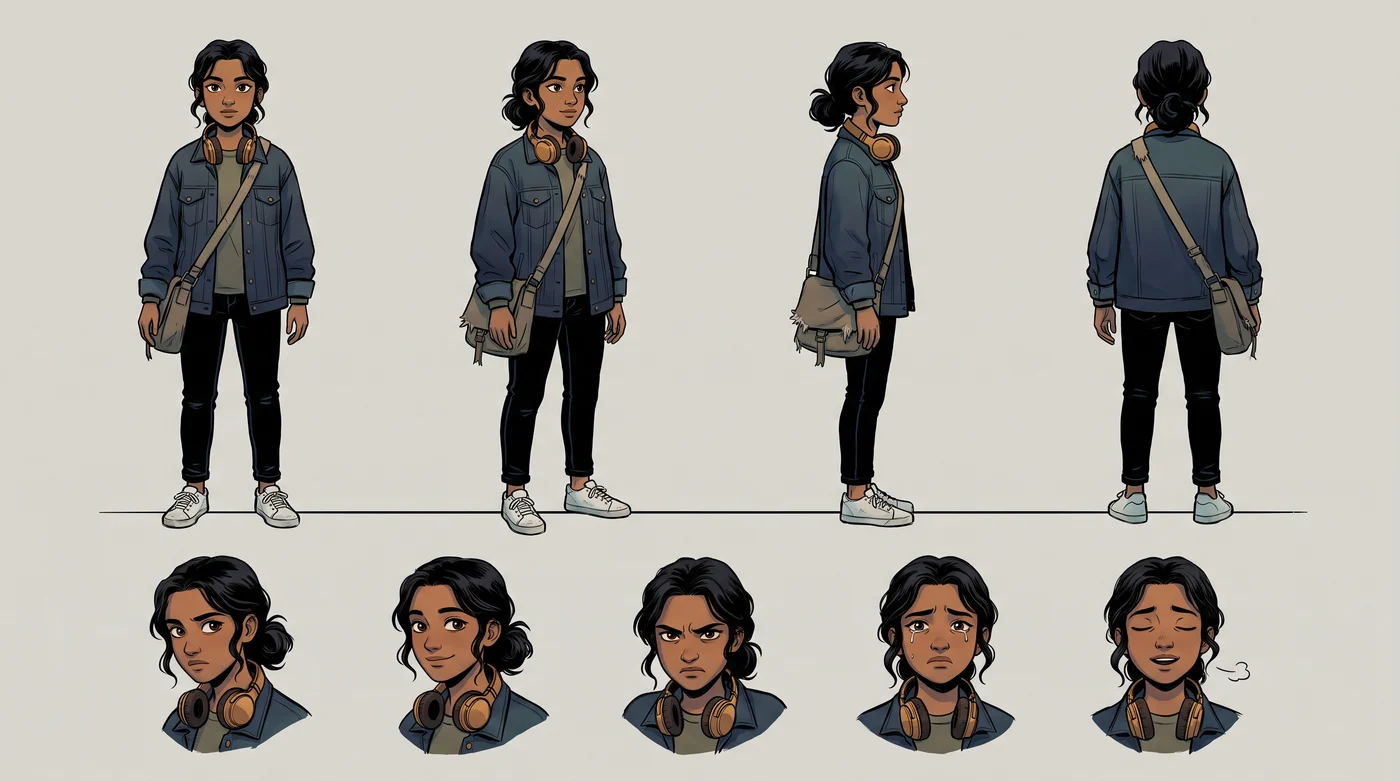
Character turnaround & expression sheet
Four views on one baseline and five expressions, drawn flat and evenly lit because a model sheet is a reference document before it is a picture. Every later panel is drawn from this.
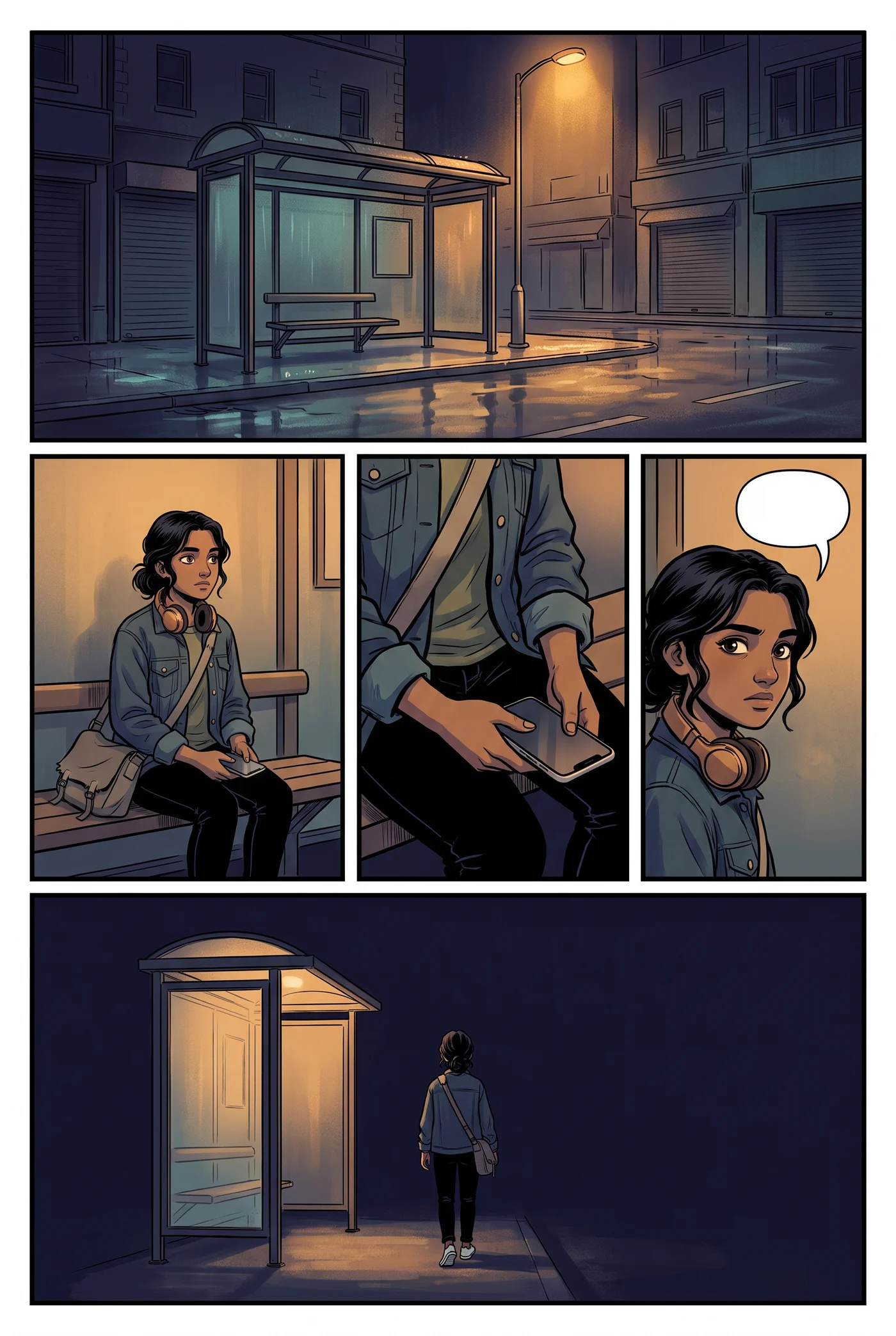
Finished page — night exterior
Five panels: a wide establishing shot, three tightening beats, then a full-width panel that pulls all the way back out. The last panel is the whole point — she is small in it, and the silence is the storytelling.
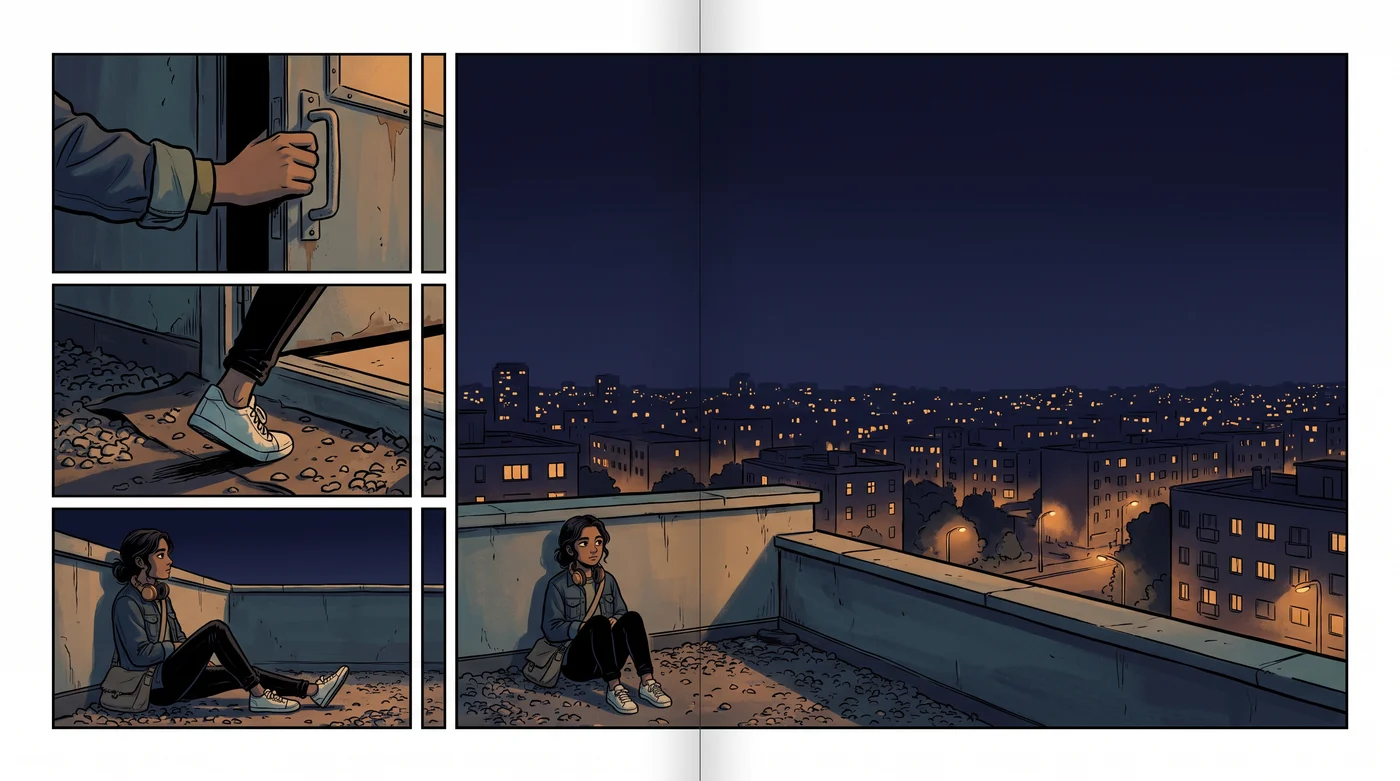
Double-page spread
Three narrow stacked panels against one full-height panel. Scale contrast across the gutter is how a spread earns its two pages instead of being two pages that happen to touch.
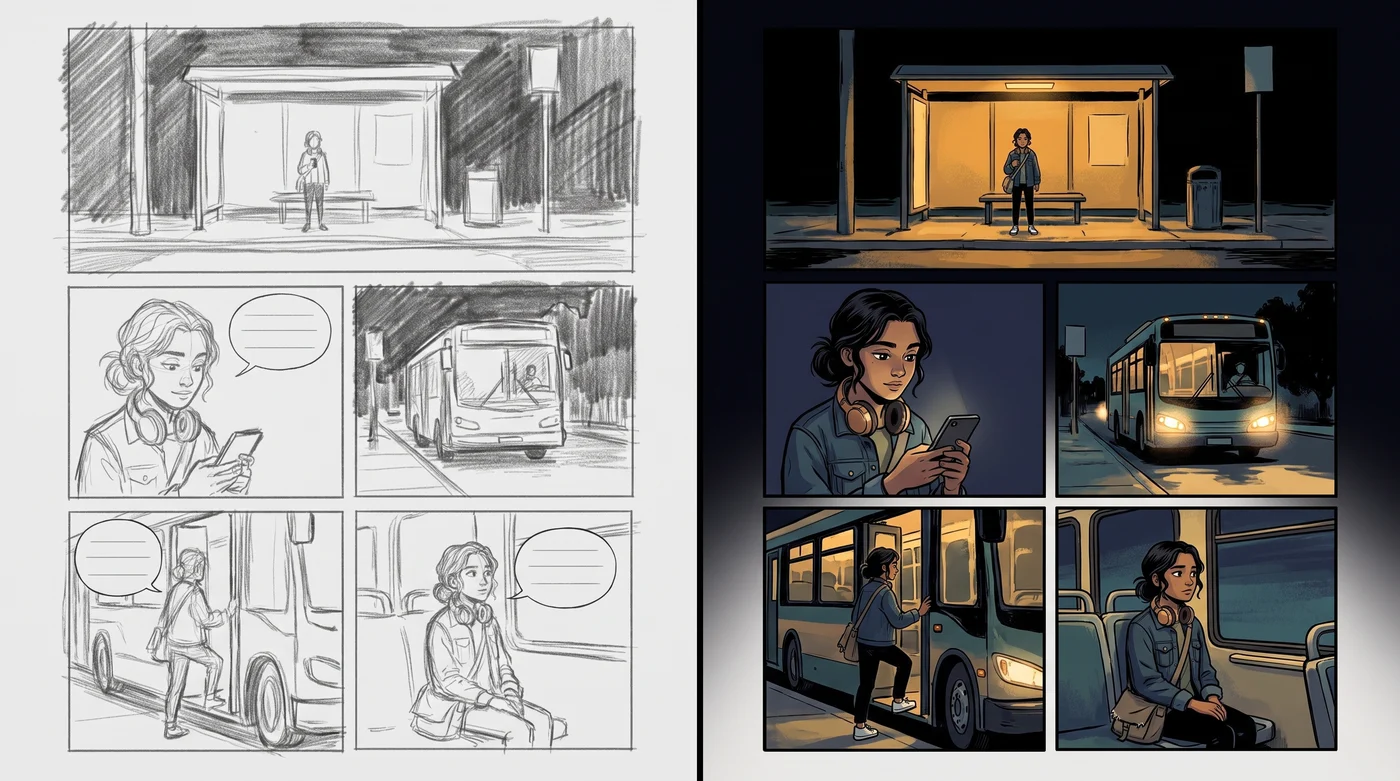
Thumbnail to finished page
The same page twice on the same grid: the rough where panel order, staging and balloon positions are agreed, and the finish built on it. Notes are cheap on the left and expensive on the right.
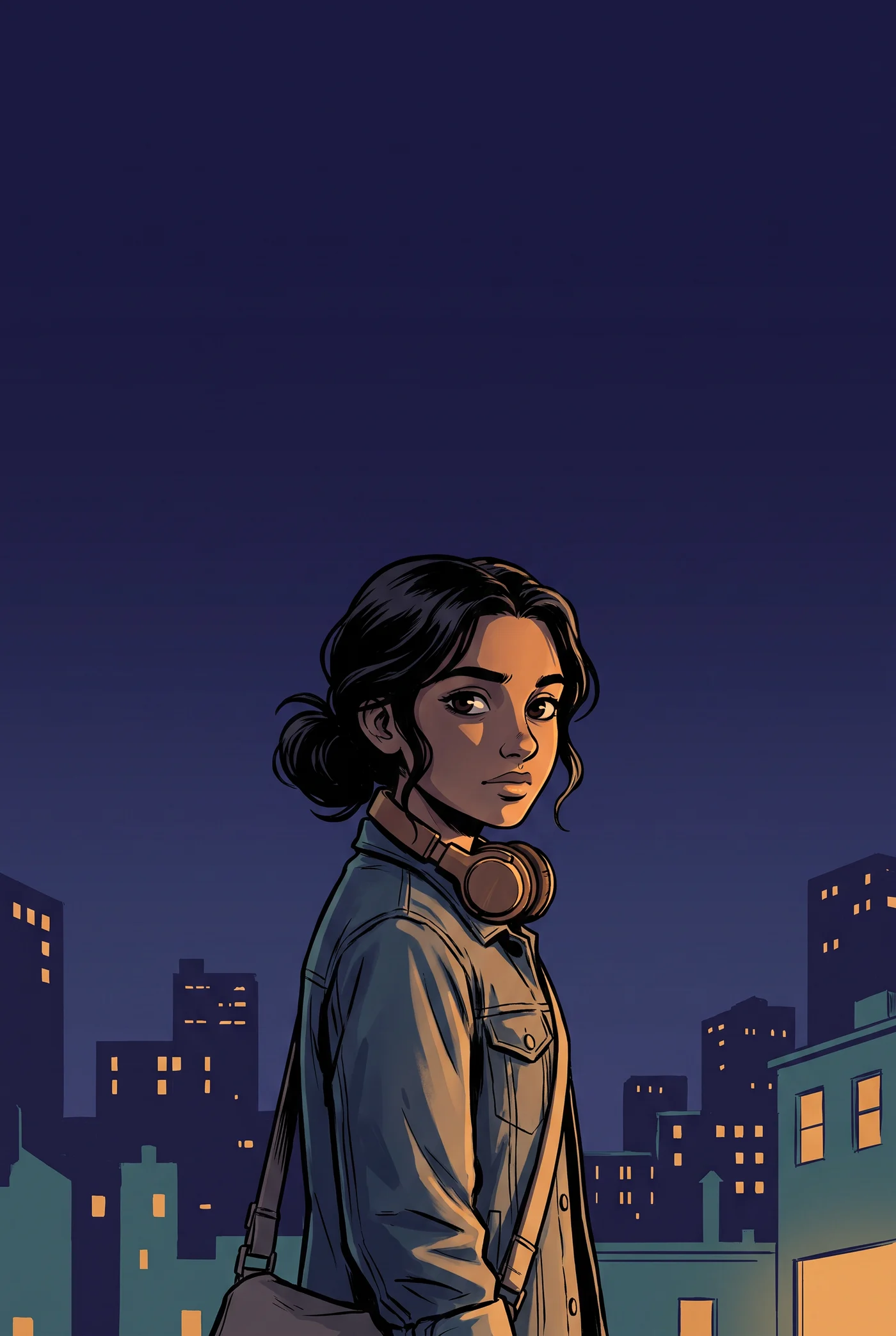
Cover, before lettering
Composed around the space a title needs rather than around the figure, with the upper third deliberately left open. Type is set afterwards, so the art is never fighting the words it has to carry.
Studio demonstration pieces made to show register and process — not client commissions.
N° 01The register
What actually changes when the reader turns twelve.
Age band is a craft decision long before it is a marketing one. It sets panel density, how much of a page a single beat may occupy, how dark the palette can go before it stops reading on cheap paper, and whether a moment can be allowed to land in silence.
A middle-grade page keeps things moving because a nine-year-old reader disengages when it does not. A young-adult page can hold still for a full tier — and often should. Getting that wrong is the most common reason a book aimed at teenagers reads as though it was made for children.
01
Fewer panels, more air
Four to six panels where a middle-grade page runs seven or eight, so individual moments get the room to register instead of being clipped.
02
Silence as a beat
Wordless panels and wordless tiers used deliberately. The sample page below ends on one, because that is where the weight is.
03
A palette that can go dark
Night, interiors and low light, scored so the book still reads on uncoated paper rather than only on a backlit screen.
04
Subject matter that is not softened
Grief, conflict, isolation and first independence, drawn straight. What we do not do is gratuitous — restraint reads as respect to this age band.
05
Bodies that look like people
Grounded proportions and real body language rather than heroic or cartoon shorthand, so a reader recognises themselves in the cast.
06
Not manga by default
We will draw manga-influenced work if that is your book. We will not default to it because a character is a teenager.
N° 02Consistency
One character, two hundred pages later.
This is the question every graphic-novel buyer is really asking, and it is the one a portfolio of single illustrations cannot answer. A character who drifts between chapters quietly tells the reader that nobody was minding the book.
So the work starts with a model sheet, and every page afterwards is drawn against it rather than from memory. The samples below are one cast on purpose — the turnaround, the page, the spread and the cover are the same person, and you can check that yourself rather than take our word for it.
01
Model sheet first
Four views on a shared baseline plus an expression range, approved before a single page is drawn.
02
Drawn against the sheet
Every subsequent page references it directly, so the face, the build and the wardrobe hold across the book.
03
A style bible for longer books
Palette, line weight, lettering rules and location references, written down so chapter twelve matches chapter one.
04
A consistency pass at the end
The whole book reviewed as a book, not as a stack of pages, with corrections made before print prep.
N° 03Scoping
What a budget actually buys.
Comic work is priced by the page, and pages are not interchangeable. A quiet two-hander in one location and a crowd scene across a city are the same page count and nowhere near the same job — panel density, background load, cast size and colour treatment are what move the number.
That means a fixed budget buys a page count, and the honest conversation is which pages are worth spending it on. A strong twenty-page excerpt that shows the book at full quality does more for a pitch, a crowdfunder or an agent than sixty rushed pages do.
01
Start with a sample chapter
Most first projects here begin as an opening chapter or a pitch excerpt, finished properly, rather than a whole book made thin.
02
Density is the real variable
Send the script or a synopsis and we count panels, not just pages, before quoting.
03
Staged by chapter
Longer books run in scheduled batches so cost and schedule stay visible and you can stop at a chapter boundary.
04
Nothing starts before the number is agreed
Scope, page count and price are settled in writing first. There are no per-page surprises later.
Investment
Named engagements. Quoted per project.
Three shapes, from a pitch excerpt to a complete book. Every graphic novel is a different length at a different density, so each is quoted per project rather than sold from a price list.
Pitch excerpt
Quoted per project8–24 pages
An opening chapter or excerpt to take to agents, publishers or a crowdfunder.
- Character model sheet
- Script breakdown & thumbnails
- Finished pages in the book's style
- Colour and lettering included
- Cover illustration
- Print-ready and digital files
Single volume
Quoted per project24–48 pages
A complete short volume, or the first instalment of a series.
- Everything in Pitch excerpt
- Style bible for the series
- Page architecture scored against the script
- Cover plus one variant
- Webtoon vertical cut available
- Promo crops for launch
Full graphic novel
Quoted per project60+ pages
A complete book, produced in scheduled chapter batches.
- Everything in Single volume
- Chapter-by-chapter schedule
- Consistency pass across the whole book
- Print, webtoon and ebook builds
- Layered working files handed over
- Full rights transfer on completion
Quoted per project, because page count alone does not describe the work — panel density, cast size, background load and colour treatment are what move the number. If you have a budget in mind, say so up front and we will tell you honestly what it covers rather than quoting a book you cannot afford to finish.
Questions
The answers we give most often.
- I have a fixed budget. How many pages does it cover?
- Tell us the number and we will answer it directly rather than making you guess. As a rule of thumb, budget buys pages and density decides how many — a talky two-hander goes considerably further than a crowd scene. Most first projects at a defined budget become a finished opening chapter rather than a thin whole book, because an excerpt at full quality is what actually opens doors.
- Is this manga? My readers expect a certain look.
- It can be, if that is genuinely your book. What we will not do is default to manga or anime styling just because the cast is teenaged — the samples here are deliberately in a Western YA register, brush ink with cinematic lighting. Send two or three books whose look you want to sit beside on a shelf and we will tell you plainly whether we are the right studio for it.
- Can you keep one character consistent across a whole book?
- That is what the model sheet is for, and it is why the samples on this page are one cast rather than five unrelated pieces. Every page is drawn against the approved sheet, longer books get a written style bible, and the whole book gets a consistency pass before print prep.
- Do you letter, or do I need someone else?
- Lettering is included. Balloons are placed as part of the page architecture — they steer the eye and they are a drawing decision, not an afterthought. You will notice the balloons in the samples are empty: that is what a page looks like at handover, shapes placed and tails aimed, with your words set into them.
- What do you need from me before you can quote?
- A script or a synopsis, the page count you have in mind, the age band, and where it is being published — print, webtoon or ebook. If a script does not exist yet, a beat outline is enough to scope from. Budget and deadline help us tell you what is realistic in the first reply rather than the third.
- What kinds of story won't you take?
- Romance and erotica, and anything with explicit or adult content — that is a studio-wide line and it does not move on budget or page count. It is worth saying plainly on a young-adult page, because YA and new adult shade into explicit romance faster than any other shelf, and finding out three chapters in helps nobody. Difficult subject matter is a different question entirely: grief, conflict, violence and isolation are part of writing honestly for this age, and we draw them straight.
- Who owns the artwork?
- You do, on completion and full payment — including layered working files on the full graphic novel engagement. We work on original stories only. We do not take romance, erotica or adult projects, and we never work on licensed or third-party properties.
Next step
Send us the script.
A synopsis is enough to start. Tell us the age band, roughly how many pages, where you plan to publish, and the budget you are working to — we will reply within two working days with what it covers and what we would draw first.